

The first complaint usually does not come from your QA lab — it comes from the filling line supervisor who notices that this lot of phosphatidylserine powder looks darker than last month's, or from marketing, comparing capsules from two production runs side by side. You pull the COA: appearance "conforms." You pull the specification: "white to pale yellow, free-flowing powder, bland odor." Against those words, almost anything conforms, which is precisely the problem. Organoleptic attributes are the least specified and most disputed parameters in phospholipid sourcing, and in a plant-based ingredient like PS — where feedstock, enzyme processing, and oxidation all shift color and odor — vague sensory language guarantees repeat disagreements with your supplier. This article shows US and EU buyers how to write measurable organoleptic acceptance criteria, run a defensible receiving check, and investigate a drifted lot before it becomes a finished-product recall question. Buyers preparing this documentation can review our phosphatidylserine programme alongside the grade, source and market detail above.
Why Organoleptic Specs Cause the Most Disputes
Color, odor, and appearance are on every PS spec sheet, and they are the only release parameters usually judged by a human with no instrument. Three failure modes recur:
- Undefined vocabulary. "Pale yellow" means different things to different inspectors, and to different cultures of inspectors on different continents. A US buyer and an EU manufacturer can both be right and still disagree.
- No reference anchor. Without a retained reference sample or a numeric color target, the specification has no fixed point, and each new lot becomes the new normal — classic spec drift, where acceptance creeps lot by lot until the powder is visibly tan.
- Odor judged without conditions. Fatty, waxy notes in phospholipids are normal at low intensity; rancid notes are not. Without a defined intensity scale and lighting/temperature conditions, odor calls are not reproducible.
Auditors notice. A supplier audit or a US GMP records review that finds "conforms" written against an unmeasurable attribute with no reference standard is a documentation finding waiting to happen.
Why PS Powder Drifts in Color and Odor
Phosphatidylserine powder is produced by enzymatic transesterification of lecithin — soy or sunflower derived — followed by separation, concentration, and drying. Each step can move the sensory attributes:
- Feedstock variation. Sunflower lecithin lots tend toward lighter base color than soy; harvest year and oil refining conditions shift the baseline either way.
- Process temperature and residence time. Higher drying temperatures and longer holds accelerate Maillard-type browning and phospholipid oxidation, both of which darken powder and add odor.
- Oxidation. Progressive peroxide value and anisidine value increases track with rancid or "cardboard" notes; a lot at the top of a ≤5 meq/kg peroxide limit will rarely smell the same as one at 1 meq/kg.
- Moisture and caking. Hygroscopic powder that picks up moisture in poorly sealed packaging develops lumps and surface discoloration that inspectors describe as "appearance drift."
- Carrier changes. A supplier switching carrier or lecithin source — a change that must be notified under your change-control terms — often shows up first as a color shift.
This is why color drift is a signal, not just a nuisance: it is frequently the first visible symptom of an oxidative or process trend that the chemical specs will confirm later.
Writing Objective Organoleptic Acceptance Criteria
Convert the vague line into measurable criteria. A defensible PS organoleptic spec has four components:
1. Instrumental color band. Specify color by spectrophotometer in CIELAB terms — for example, L* ≥ 85, with a* between −1 and +4 and b* ≤ 18, measured on compressed powder tablets with a D65 illuminant. Agree the exact instrument geometry (e.g., d/8) and method with the supplier, and record baseline L*a*b* values from the qualification lots. Numbers end the vocabulary debate.
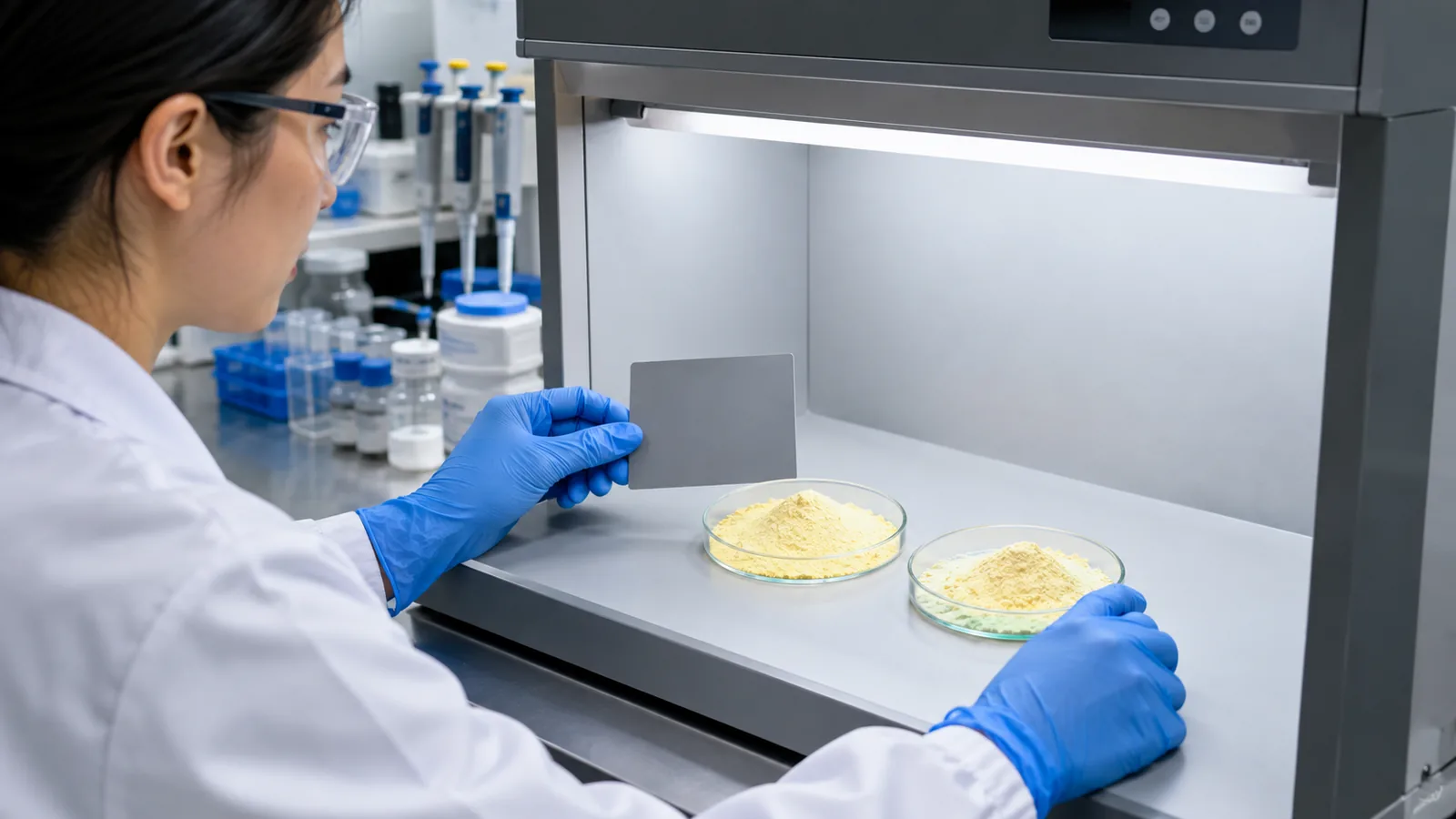
2. Retained reference standard. Require the supplier to hold — and you to receive with each new qualification or annually — a sealed reference sample from a good production lot, stored cold and protected from light. Receiving inspection compares against the reference under defined lighting (D65 or a north-light booth), not against the inspector's memory.
3. Odor intensity scale. Replace "bland odor" with a defined scale: "0 = odorless, 1 = bland fatty/waxy (acceptable), 2 = noticeable fatty, no rancidity (acceptable), 3 = rancid or off-notes (reject)." Panel members sniff the powder freshly opened at room temperature, 15–20 °C.
4. Appearance descriptors with limits. "Free-flowing powder, essentially free of visible specks; no more than faintly visible dark specks when viewed against a white background at 30 cm; no hard caking; slight surface compaction acceptable if dispersible with gentle pressure."
An example consolidated line for the spec sheet: "Color: L* ≥ 85 (D65, d/8, compressed tablet); Odor: ≤2 on 0–3 scale (0 = odorless, 3 = rancid); Appearance: free-flowing, no hard lumps, dark specks not visible at 30 cm against white background; assessed against retained reference lot [code]."
Receiving Inspection: A Practical Sensory Checklist
At the warehouse, before releasing the lot to stock:
- Verify seal integrity of drum and liner before opening — a compromised liner changes the sensory question entirely.
- Compare powder color against the retained reference in a light booth at 30 cm.
- Sniff test on opening, on the 0–3 scale, by at least two trained people; record both calls.
- Check for caking: invert a filled drum gently, then open; powder should flow freely.
- Screen for specks against a white background; if visible specks are present, escalate to the foreign-matter procedure rather than the sensory disposition.
- Photograph the opened drum and the powder surface with a color card in frame — photographs settle disputes months later.
- Record results on the incoming inspection record with lot number and reference code; "OK" alone is not a record.
If the lot is borderline on color or odor, hold it and pull peroxide value and moisture — the chemistry usually explains the sensory reading within 48 hours.
Investigating and Dispositioning a Drifted Lot
When a lot fails or sits at the sensory limit:
- Quantify. Run L*a*b*, peroxide value, anisidine value, moisture/water activity. Sensory drift with normal PV is a process or feedstock issue; sensory drift with rising PV is oxidation — different conversations with the supplier.
- Notify and request data. Ask the supplier for the lot's release data, process records, and any change notifications (carrier, lecithin source, dryer conditions). A genuine drift event should trigger their CAPA, not just a replacement shipment.
- Disposition deliberately. Options are accept-as-is (documented concession, only if chemistry is in spec and your finished product tolerates the shade), rework where permitted (none for sensory attributes in practice), or reject and replace. Never blend a drifted lot into good lots without a documented blending study — you distribute the defect across every unit instead of containing it.
- Update the standard. After every drift event, refresh the retained reference, confirm the L*a*b* band still reflects market expectations, and log the event into your supplier scorecard so chronic sensory drift shows up at contract renewal.
| Attribute | Objective limit (example) | Verification |
|---|---|---|
| Color L* | ≥ 85, D65, d/8 | Spectrophotometer |
| Odor | ≤ 2 on 0–3 scale | Trained 2-person panel |
| Appearance | No visible specks at 30 cm | Visual vs white background |
| Caking | Free-flowing after inversion | Physical check |
| Reference | Retained lot on file | Annual refresh |
FAQ
Q: Is color drift in phosphatidylserine powder a safety issue?
A: Usually a quality signal rather than a safety hazard in itself, but it can be the first symptom of oxidation. Sensory drift with rising peroxide or anisidine values is a shelf-life and sensory-quality risk for your finished product and should stop shipment of affected lots.
Q: We have no spectrophotometer. Can we still control color objectively?
A: Yes, partially. Retained reference samples, a defined light source, and photographic records with a color card give you a defensible visual standard. But for chronic drift disputes, an L*a*b* measurement — outsourced to a local lab at low cost per test — is the fastest way to end disagreement.
Q: Can I reject a lot for odor if the COA says everything conforms?
A: Yes, if your purchase specification defines the odor scale and your inspection procedure documents the panel result. Without a defined scale in your spec, rejection becomes a negotiation rather than a compliance decision — which is exactly why the scale belongs in the specification.
Q: Should the supplier's reference sample or mine govern?
A: Your specification should name one governing reference — commonly the supplier's sealed reference received at qualification, archived by both parties. If yours and theirs drift apart, investigate storage first before assuming either lot changed.
Q: Does sunflower PS drift less than soy PS?
A: Not inherently. Both oxidize; sunflower-derived PS often starts lighter in color, so the acceptable band and reference standard simply differ. Judge each source against its own reference, never against the other.
Conclusion
Organoleptic drift in phosphatidylserine powder is not an unavoidable mystery — it is a specification gap. Undefined color and odor language lets acceptance creep lot by lot, and it hides the early oxidative and process signals that sensory attributes carry. Convert the vague spec line into an L*a*b* band, a defined odor scale, a retained reference, and a documented receiving check, then investigate every borderline lot with chemistry before disposition. Suppliers respect numbers, auditors accept records, and your filling line stops being the first QC checkpoint in the plant. When you are ready to move from checklist to quotation, contact our team with the grade, source and document set described above.
Sources
- FDA — 21 CFR Part 111, Current Good Manufacturing Practice for Dietary Supplements (master records and component specifications): https://www.fda.gov/regulatory-information/title-21-code-federal-regulations-part-111-current-good-manufacturing-practice-dietary-supplements
- ISO 8586:2012 — Sensory analysis — General guidelines for the selection, training and monitoring of selected assessors: https://www.iso.org/standard/45352.html
- AOCS Official Methods — Peroxide Value, Cd 8b-90: https://www.aocs.org/attend-methods-methods
- EUR-Lex — Regulation (EU) No 1169/2011 on food information to consumers: https://eur-lex.europa.eu/legal-content/EN/TXT/?uri=CELEX%3A32011R1169
- ASTM E313 — Standard Practice for Calculating Yellowness and Whiteness Indices from Instrumentally Measured Color Coordinates: https://www.astm.org/e0313-20.html
Buyer fit
Who this guide is for
This guide is written for the buyer profiles below. Open your profile for the matching grades, documents and next steps, or tell us your requirements directly.
Recommended next steps
- Review the Phosphatidylserine product page.
- Compare Soy PS and Sunflower PS.
- Check manufacturing proof and Quality & R&D.
Contact sales for product documents
Share source preference, application, country, and annual quantity.
Contact Sales