

A container of phosphatidylserine is a poor candidate for improvisation at the port: it is a high-value, moisture-sensitive ingredient whose COA was issued against a specific lot, and every day parked in a terminal adds demurrage charges, delays production, and stretches the retest clock quality teams live by. Yet demurrage and detention remain among the most underestimated costs in ingredient importing. Ports do not congest randomly: it follows schedule reliability, exam rates, labor events, and seasonal export surges, all of which can be anticipated. This guide breaks down the three charge types buyers confuse, maps dwell-time risk on a PS import lane, and provides a pre-shipment checklist and inventory strategy that make port delay a managed cost line.
!Aerial view of a congested container terminal with stacked containers and gantry cranes For the specification detail behind these documents, see our quality and R&D overview, including test methods and release criteria.
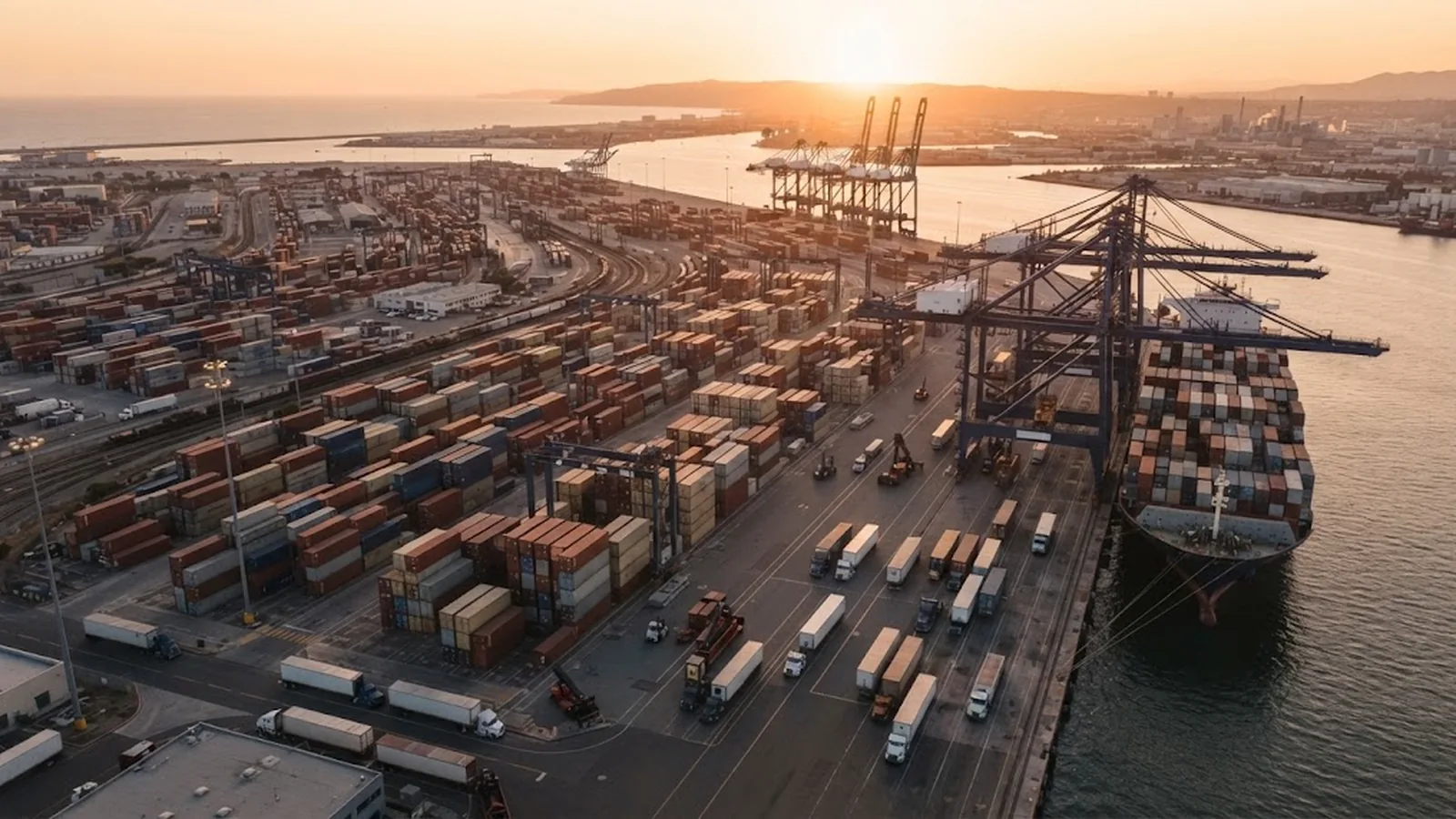
Demurrage, Detention, and Storage: Three Charges Buyers Confuse
Demurrage is charged when a loaded container remains inside the terminal beyond the agreed free time — typically three to seven days after discharge. Detention is charged when the container is outside the terminal but not returned empty within the free period — a trap that usually springs inland when a consignee unloads slowly. Port storage is the terminal's own warehousing charge, and customs examination adds fees for equipment handling, exam site storage, and drayage.
Three structural facts shape the exposure. Free time is contractual and negotiable: forwarders with volume can frequently negotiate five to seven days at destination, and the negotiation belongs at booking. Charges escalate — daily rates step up after each free-time block, so a container stuck two weeks can cost multiples of one stuck one week. Under FOB and CIF terms the buyer typically bears these destination charges, making them a procurement problem. A specialty ingredient container can accumulate four-figure charges within days.
Where Congestion Risk Enters an Ingredient Supply Chain
Congestion risk begins upstream of the port. Carriers blank (cancel) sailings when demand softens and stack vessels when demand spikes; a missed sailing on a weekly service adds a full seven-day cycle. Transshipment adds a second discharge-and-reload exposure and doubles the consequence of hub backlog. Schedule reliability varies by lane; lanes serving Asian export hubs have swung 20 percentage points or more across a year.
At the destination port, dwell accumulates through distinct failure points: terminal backlog from vessel bunching, chassis shortages that prevent pickup, labor actions or weather closures, and — most relevant to food ingredients — customs and FDA examination holds. An exam hold commonly adds three to ten days. The exam is routine; the cost consequence comes from documentation readiness, because inconsistent paperwork both raises the probability of an intensive exam and lengthens the hold.
Congestion Hotspots and Seasonal Windows for US and EU Importers
Every import lane has a congestion calendar; plan against it rather than discover it. On US West Coast lanes, Los Angeles and Long Beach are the structural hotspot, with pressure points at Chinese New Year (the pre-holiday export surge), mid-year labor contract risk, and the Q4 retail peak from August through October. East Coast lanes through Newark, Savannah, and Houston carry different exposures — Panama Canal restrictions showed how a distant chokepoint can reroute capacity between coasts overnight.
In Europe, Rotterdam, Antwerp–Bruges, and Hamburg dominate, and their stress follows inland barge and rail capacity as much as vessel arrivals: when Rhine water levels drop or rail actions hit, containers queue at the quay even with the terminal nominally open. The rules hold across regions: build buffer around Chinese New Year and Golden Week, expect Q4 peak pressure on US lanes from late summer, and book two to three weeks early when labor negotiations are announced, with free-time terms confirmed at booking.
Documentation and Filing Levers That Reduce Dwell Time
Dwell time responds to paperwork more than most buyers expect. On US lanes, a timely Importer Security Filing (filed 24 hours before loading) removes an early-arrival penalty exposure, and pre-filing the customs entry lets the broker request release on arrival. A complete, internally consistent document pack — invoice, packing list, bill of lading, certificate of origin, COA matching the lot and quantity, and FDA Prior Notice where applicable — is the single strongest reducer of exam dwell: discrepancies between documents escalate a routine exam into an intensive one, and a fast broker pre-alert shortens every queue it joins.
On EU lanes, the equivalent levers are a pre-lodged import declaration, an EORI number in good standing, correct HS classification, and supplementary documents assembled before the vessel's ETA. Both regions reward the same behavior: the import file finished before departure. Buyers who assemble documents pre-shipment consistently show shorter median dwell than those who start when the container is already in the yard.
A Pre-Shipment Demurrage Risk Checklist
Before each PS shipment departs, procurement and logistics should tick every box:
- Free time confirmed in the booking: destination free days (target 5–7 where negotiable) and combined demurrage/detention terms understood.
- Daily charge schedule documented: rates, escalation steps, and who pays under the agreed incoterm.
- Vessel ETA and transshipment plan checked; alternative sailing identified for high-risk windows.
- ISF/ENS and customs entry pre-filed; document pack consistent — quantities, lot numbers, and weights match across invoice, packing list, B/L, and COA.
- Broker pre-alert scheduled at departure, with the entry filed pre-arrival and exam contingency options discussed.
- Drayage and chassis reserved for the arrival window; inland delivery agreed with the receiving warehouse with a week of buffer; a fallback warehouse identified.
- Exam-fee responsibility and a cost reserve line agreed internally, so a hold does not freeze the decision chain.
Inventory Buffers and Routing Strategies
The structural answer to port congestion is to stop letting the port set your production calendar. Safety stock should be expressed in days of cover and calibrated to lane risk: a lane with 85% schedule reliability, a transshipment stop, and a history of exam holds justifies more buffer than a direct, high-reliability service. Many ingredient buyers converge on four to six weeks of cover on congested lanes versus two to three on stable ones, set against shelf life and retest period.
Routing carries the same logic. Direct services avoid the transshipment hub that generates much of the exposure; dual-port routing — qualifying two destination ports with comparable inland legs — turns a single-port backlog from a stoppage into a routing decision; split shipments across sailings trade a small freight premium for a smoother arrival cadence. Finally, track the data: per-lane on-time performance and historical dwell at your destination terminals turn next year's booking negotiations from opinion into evidence — and forwarders respond to numbers.
FAQ
Q: What is a reasonable free-time target to negotiate for ingredient containers?
Five to seven destination demurrage days is a realistic target on major US and EU lanes, particularly with forwarders who can aggregate volume. Negotiate at booking and cover combined demurrage/detention terms. Standard three-day free time leaves little room for an exam hold — the scenario most likely on a food ingredient container.
Q: Does choosing CIF increase my demurrage exposure compared with FOB?
The exposure ultimately sits with whoever controls the container at destination, typically the buyer under either term. Under CIF the seller selects the carrier and routing, so the buyer inherits terms it did not negotiate; under FOB the buyer writes free time, routing, and pre-alert discipline into its own booking. The difference is who negotiated the fine print.
Q: Is paying demurrage ever cheaper than paying for more inventory buffer?
Occasionally, yes — and that comparison should be made explicitly. Safety stock ties up capital, consumes retest-period life, and occupies warehouse space; demurrage risk is intermittent. Price both: annual exposure estimated from lane history against the carrying cost of extra buffer weeks. A calibrated buffer plus disciplined pre-filing beats either extreme.
Conclusion
Demurrage and detention are not random surcharges but the priced consequence of congestion patterns, exam risk, and paperwork readiness — all plannable. Buyers who negotiate free time at booking, pre-file documentation before departure, reserve drayage against realistic windows, and hold a calibrated buffer on congested lanes routinely spend less on port delay than buyers who treat each container as it comes. For a high-value ingredient like phosphatidylserine, the logistics plan is part of the quality system: build the checklist into every shipment and review lane data annually; congestion becomes one managed cost line among many. When you are ready to move from checklist to quotation, contact our team with the grade, source and document set described above.
Sources
- US Federal Maritime Commission — demurrage and detention billing guidance
- US Customs and Border Protection — basic import and entry guidance
- FDA — Prior Notice of Imported Food
- Port of Long Beach — port operations information
- Port of Rotterdam — terminal and inland logistics information
Buyer fit
Who this guide is for
This guide is written for the buyer profiles below. Open your profile for the matching grades, documents and next steps, or tell us your requirements directly.
Recommended next steps
- Review the Phosphatidylserine product page.
- Compare Soy PS and Sunflower PS.
- Check manufacturing proof and Quality & R&D.
Contact sales for product documents
Share source preference, application, country, and annual quantity.
Contact Sales