

When a phosphatidylserine supplier writes "24 months shelf life" on a specification sheet, that number usually rests on the supplier's own stability data — sometimes a full real-time study, sometimes an accelerated study stretched with a little arithmetic, and occasionally nothing more than an industry convention that everyone repeats and nobody tests. For most commodity ingredients the risk of accepting the claim at face value is modest. For a concentrated phospholipid that oxidizes, cakes and drifts sensorially, it is not: the difference between a genuine two-year shelf life and a hopeful one lands directly on your inventory write-offs, your finished-product expiry support and your customer complaints.
US and EU buyers increasingly close this gap by commissioning their own stability work. Borrowed from the ICH framework that governs pharmaceutical stability studies and scaled down for dietary supplement raw materials, an accelerated stability protocol puts the ingredient under elevated temperature and humidity for three to six months and watches which specifications move. The exercise is not about proving the supplier wrong. It is about converting a printed number into evidence you own, before a two-container order turns the question expensive.
This guide walks through how to design that protocol: what ICH-style conditions mean for a sensitive lipid powder, which attributes to track and when to pull samples, how to interpret accelerated results without over-extrapolating them, and how a retention sample program ties the whole effort together.
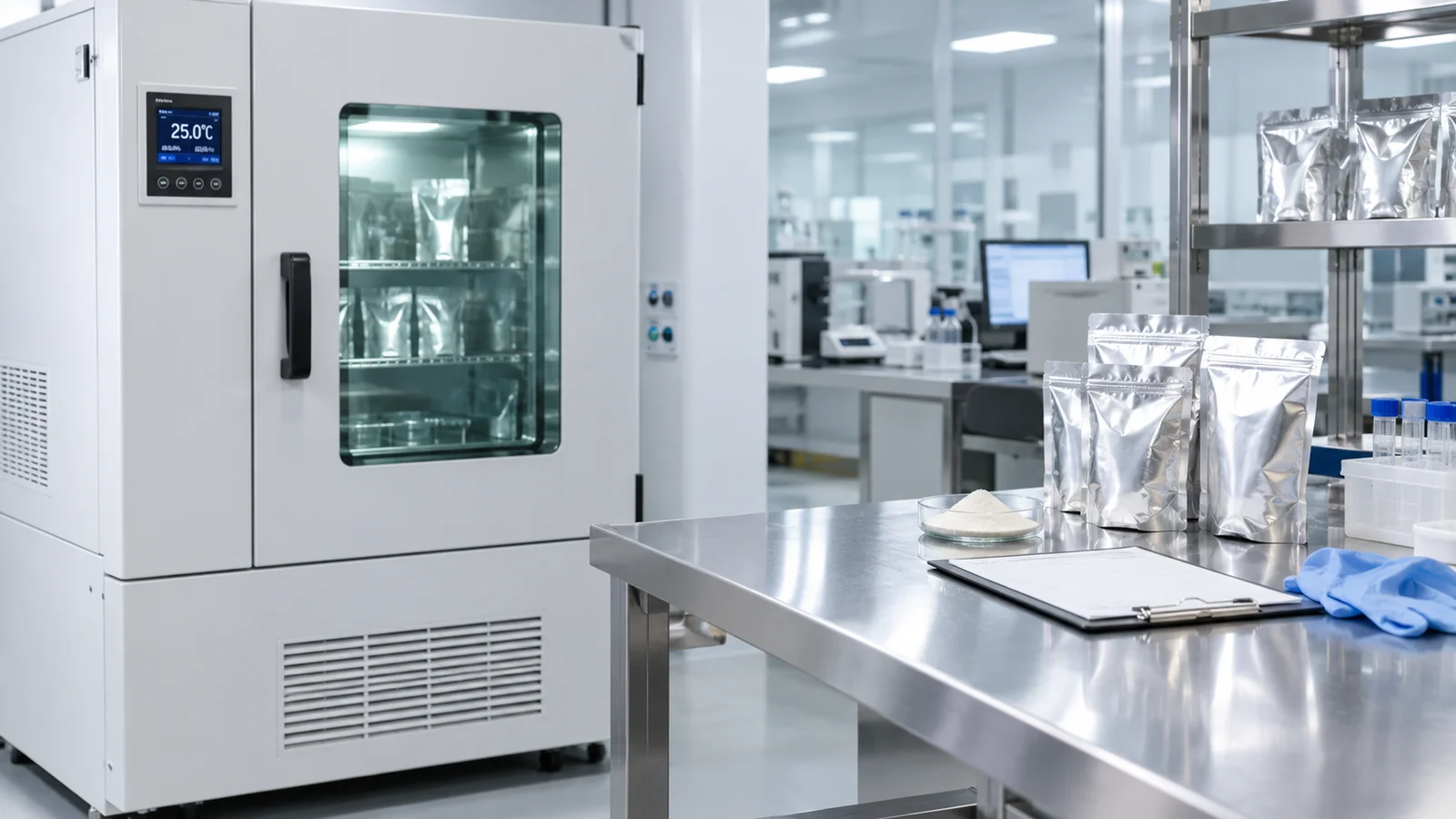
!Phosphatidylserine powder samples in foil bags on a laboratory bench beside a climate stability chamber Where supplier qualification is the next step, our manufacturing overview documents the facility, process controls and batch records behind each lot.
Why buyers commission their own stability work
A supplier's stability study answers the supplier's question: how long can we release this lot for sale? A buyer's stability study answers a different question: how does this ingredient behave in our warehouse, in our finished product matrix and against our label claims? Those are related but not identical questions. The supplier's study may have been run on a different derivation, a different carrier system or a different packaging format than the lot you are actually buying; it may predate a process change that the change-notification clause in your quality agreement quietly let through.
Buyer-side stability work also carries commercial weight: if your finished product's expiry claim leans on the ingredient's shelf life, auditors increasingly expect that link to be documented, and a supplier whose powder holds peroxide value flat under stress is telling you something no quotation reveals.
What ICH-style conditions mean for a phospholipid powder
The ICH Q1A framework defines standard storage conditions for pharmaceutical stability studies: long-term storage at 25°C/60% RH, and accelerated storage at 40°C/75% RH designed to compress years of degradation into months. Supplement raw material buyers rarely replicate the full pharmaceutical apparatus, but the logic transfers well.
For a phospholipid powder, the accelerated condition is a genuine stress test rather than a formality. Lipid oxidation roughly doubles per 10°C rise, so six months at 40°C probes what two years at ambient might do — and 75% humidity simultaneously tests whether the powder's packaging and carrier hold up against moisture uptake and caking. The long-term arm at 25°C/60% RH, run in parallel, anchors the accelerated data to reality.
One adaptation matters: PS powder is usually sealed in high-barrier foil liners under nitrogen. If you test the powder exposed, you are testing the formulation; if you test it in its commercial packaging, you are testing the system you will actually receive. For procurement due diligence, test the system — drum, liner and all.
Designing the protocol: lots, chambers, pull points, attributes
A defensible buyer protocol needs four decisions made in writing before the first chamber door closes.
First, the lots. Test at least two — ideally one commercial lot from the incumbent supplier and one from a candidate second source, so the comparison itself becomes evidence. Second, the configuration: material packed in its commercial packaging, plus a small number of open-interface samples if you want to understand worst-case exposure during drum use. Third, the pull schedule: initial, one month, three months and six months for the accelerated arm, with matching pulls for the long-term arm. Compressed two-month screening protocols trade away the confidence a scale order deserves.
Fourth, the attributes, which should mirror the COA plus the failure modes that matter for lipids: peroxide value and secondary oxidation markers for rancidity, moisture and water activity for caking and hydrolysis, assay by HPLC for content drift, appearance, odor and taste for sensory degradation, and flowability if the powder feeds an automated line. Freeze every method and acceptance limit in a one-page protocol before the study starts; post-hoc criteria are worth nothing in an audit and less in a dispute.
Reading accelerated data without over-extrapolating
The classic error is the flat conversion: "six months at 40°C equals two years at 25°C." Reality is less obedient: oxidation does not always follow a clean Arrhenius curve, humidity-driven caking can appear suddenly, and continuous 75% RH says little about daily thermal cycling in a real warehouse.
Treat accelerated results as a directional screen with three outcomes. A clean result — peroxide value, assay and sensory holding inside limits at six months — gives strong comfort that the real-time claim is plausible. A borderline result — drift visible but within limits — tells you where your retest dates and consumption rates need to sit. A failing result — rancid odor at month three — tells you the shelf-life claim deserves a hard conversation before the next purchase order. For any public expiry claim, the long-term arm on your own formulation remains the supporting data.
Retention and reference samples: the buyer-side complement
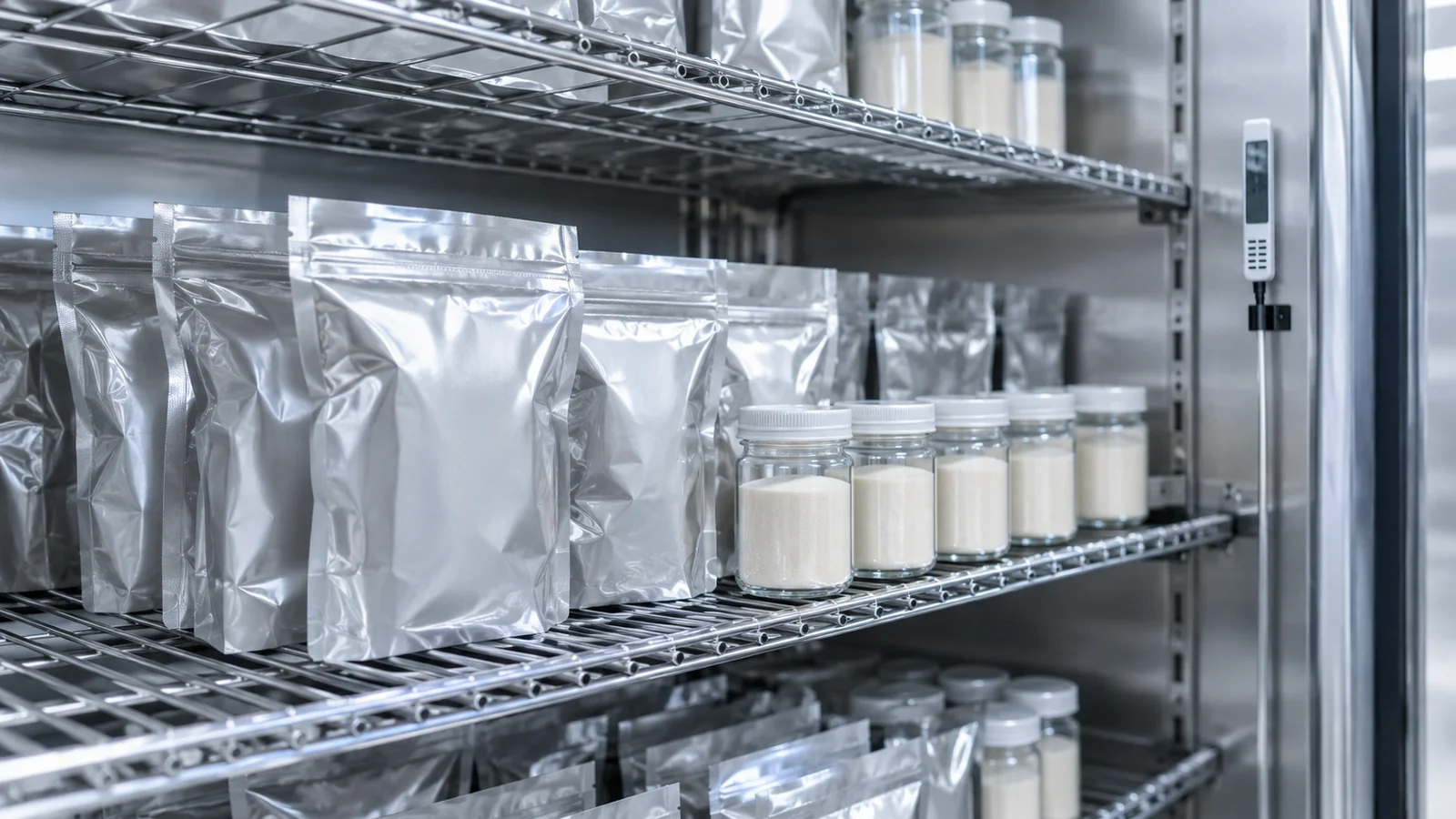
An accelerated protocol only pays off across years if you can compare future lots against the past, and that is what a retention sample program provides. US dietary supplement GMP rules already require component reserve samples held under the supplier's recommended conditions; going beyond the regulatory minimum turns compliance into intelligence.
Practical design: pull a sealed foil bag from each received lot, label it with lot number, receipt date and COA reference, and store it in a dedicated, access-controlled cabinet away from heat sources. Split it in two — a reference sample held untouched for the lot's full shelf life plus a year, and a working sample for investigations and sensory benchmarking. When someone disagrees about whether a new lot "looks right," the reference sample settles it in minutes, and an accelerated study's month-zero samples should trace back to the same lot file.
Cost, timeline and when it is worth it
Chamber time, analytical testing at each pull point and staff time make a buyer-side study a real expense, and a six-month protocol will not return an answer this quarter. The economics favor specific situations: first qualification of a new supplier, a change in derivation or packaging, entry into a market where your expiry claim will be scrutinized, or any category — like PS — where one oxidative rejection costs more than a decade of studies. For routine repeat purchases from a proven supplier, incoming COA trends are usually enough.
FAQ
Q: Can I run an accelerated stability study myself instead of using a contract lab?
A: You can hold and pull samples yourself, but the chamber conditions, temperature mapping and analytical methods are where contract laboratories earn their fee. A middle path many buyers use: you manage the protocol, pulls and decision-making, and outsource the chamber and the peroxide, moisture and assay testing.
Q: How many months at 40°C equal one year at room temperature?
A: There is no fixed conversion. A common rule of thumb treats six accelerated months as roughly two ambient years for oxidation-driven degradation, but humidity effects and packaging behavior do not scale linearly. Use accelerated data as a screen, and let real-time data support public expiry claims.
Q: Should I test the powder or the packaged drum?
A: Test the commercial packaging system — drum, liner and closure — because that is what you receive and store. Add a small number of open-interface samples if you want to understand worst-case behavior after a drum is opened in your warehouse.
Q: Does an accelerated study replace the supplier's stability documentation?
A: No. It complements it. You still need the supplier's study design and data for supplier qualification and regulatory files; your own accelerated work is buyer-side due diligence that validates how the material performs in your storage and use conditions.
Conclusion
Accelerated stability testing converts shelf-life claims from printed assurances into owned evidence. Design the protocol in writing before the first sample enters the chamber, run the accelerated and long-term arms in parallel, test the commercial packaging system rather than exposed powder, and read the results as a directional screen rather than a clock conversion. Pair the study with a disciplined retention sample program and every lot gains a physical reference point that settles disputes and anchors trends. For an ingredient where oxidation quietly erodes value in storage, that combination is among the cheapest quality insurance a procurement team can buy. When you are ready to move from checklist to quotation, contact our team with the grade, source and document set described above.
Sources
- ICH — Q1A(R2) Stability Testing of New Drug Substances and Products (reference framework for accelerated and long-term storage conditions): https://database.ich.org/sites/default/files/Q1A%28R2%29%20Guideline.pdf
- FDA — Dietary supplement CGMP, 21 CFR Part 111, reserve samples and component specifications: https://www.ecfr.gov/current/title-21/chapter-I/subchapter-B/part-111
- AOCS — official methods for peroxide value and lipid oxidation analysis: https://www.aocs.org/
- Regulation (EU) 2023/2225 context — food supplements stability and shelf-life expectations in the EU regulatory framework: https://eur-lex.europa.eu/eli/reg/2023/2225/oj
Buyer fit
Who this guide is for
This guide is written for the buyer profiles below. Open your profile for the matching grades, documents and next steps, or tell us your requirements directly.
Recommended next steps
- Review the Phosphatidylserine product page.
- Compare Soy PS and Sunflower PS.
- Check manufacturing proof and Quality & R&D.
Contact sales for product documents
Share source preference, application, country, and annual quantity.
Contact Sales