

Standard phosphatidylserine powder has two practical weaknesses: it oxidizes, and it does not always behave politely in a blender, a tablet press, or a stick-pack line. Microencapsulation — coating or embedding PS in a food-grade carrier matrix — exists to fix both. Done well, it delivers a free-flowing, low-dusting, taste-neutral powder with slower oxidation kinetics. Done poorly, it delivers an expensive dilution: a low-payload powder whose coating adds cost while failing to protect the phospholipid. For OEM buyers, the difference lies almost entirely in the specification. This guide covers the process routes, the specification parameters, fit-for-use logic by finished format, and the payload economics that determine whether an encapsulated grade is the better deal.
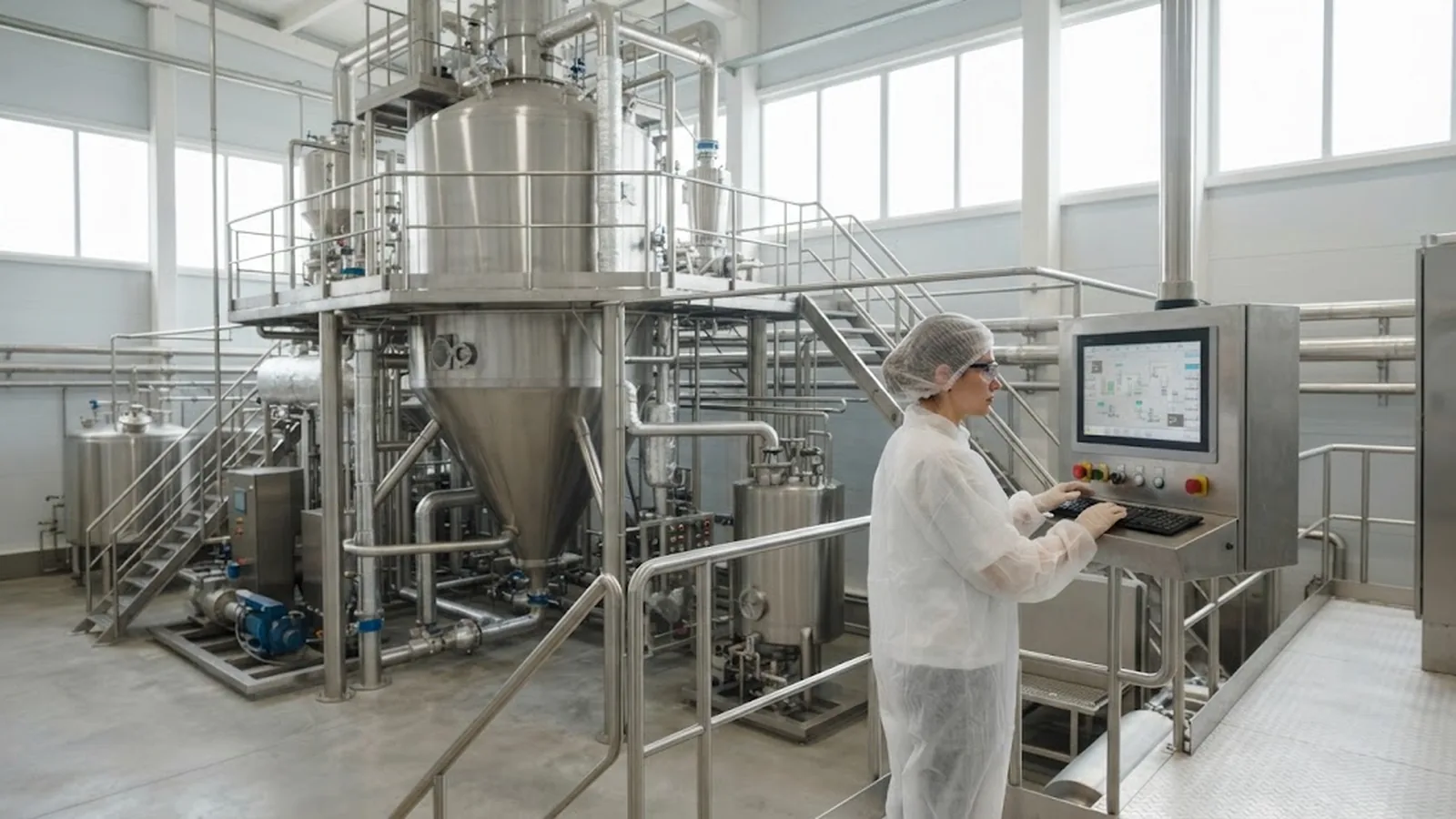
!Spray drying tower production hall where phosphatidylserine emulsion is converted into microencapsulated powder For non-GMO and European programmes, our sunflower phosphatidylserine page covers the specification and documentation set buyers typically request.
What Microencapsulation Changes in a PS Raw Material
Microencapsulation wraps PS inside a carrier matrix, typically a polysaccharide blend, and dries the composite into a free-flowing powder. Three material properties change, and each drives a specification line.
First, the assay basis shifts: a 50% powder and a 30% microencapsulated grade are not comparable unless the buyer understands what the carrier adds and what basis the percentage is measured on. Second, the oxidation barrier improves — but only if the coating is continuous and surface (free) oil is low, because unencapsulated oil on the particle surface oxidizes exactly as fast as uncoated material. Third, handling improves: particle size, flow, and dust become engineered outcomes that can be specified rather than accidents.
Two suppliers offering "30%" can differ in carrier, payload basis, surface oil, and particle distribution enough to perform differently in the same formula. The specification, not the marketing sheet, is where those differences live.
Carrier Systems and Process Routes Buyers Will Encounter
Spray drying dominates nutraceutical microencapsulation because it is scalable, food-safe, and economical. The PS emulsion is dispersed in a carrier solution — commonly gum acacia, maltodextrin, modified starch, or blends — and atomized through a hot tower where droplets dry into matrix particles. Gum acacia offers excellent film-forming and oxygen-barrier properties at higher cost; maltodextrin is cheap and neutral but a weaker oxygen barrier. Each carrier carries its own declarations: gum acacia is tree-gum (an EU-declared allergen), and maltodextrin may derive from wheat or corn.
Beyond spray drying, buyers will encounter complex coacervation (protein shells with high payloads), cyclodextrin complexation (odor control), and liposomal systems. For high-volume supplements, spray-dried particles are the pragmatic default; the exotic routes earn their premium only in specific release projects.
What separates competent suppliers from the rest is emulsion quality before drying: droplet size and stability determine surface oil, protection, and batch consistency more than the tower itself. Ask to see emulsion characterization data during qualification.
Specification Parameters Unique to Microencapsulated PS
Beyond the standard phospholipid panel (identity, assay, peroxide value, anisidine value, microbiology), microencapsulated grades require a second layer of parameters:
| Parameter | Why it matters | Typical limit (to negotiate) |
|---|---|---|
| PS payload, as-is basis | Defines dosing weight and cost per gram of actual PS | 20–50%, ±5% range, as-is |
| Assay basis definition | "Dry basis" inflates by moisture | Both as-is and dry-basis values on every COA |
| Surface (free) oil | Unprotected oil drives oxidation, dusting, sticking | ≤ 0.5–1.0% of powder weight |
| Particle size D10/D50/D90 | Blend uniformity, dust, tableting behavior | D90 ≤ 250 µm, per format |
| Moisture / water activity | Carriers are hygroscopic; Aw drives oxidation | ≤ 5.0% / Aw ≤ 0.30, carrier-dependent |
| Bulk / tapped density | Capsule count and fill-weight control | Agreed range per format |
| Wettability / dispersibility | Instant-mix and stick-pack performance | Dispersible in water at 20 °C |
| Carrier identity | Allergen, GMO, and origin declarations | Named carrier with declaration pack |
The most negotiated line is the payload basis. A COA reporting 30% PS on a dry basis at 4% moisture is 28.8% as-is — a difference that lands directly in the label claim or cost per bottle. Insist both figures appear on every COA and the PO references the as-is basis.
Matching the Encapsulate to the Finished Format
Format logic should drive the specification. In capsules and tablets, the priorities are flow, low surface oil, and payload — higher payload means smaller capsule sizes and cheaper fill weights. In powder sticks and sachets, dispersibility and taste neutrality dominate: a poorly wetting encapsulate clumps in cold water, and high surface oil returns the lecithin notes the coating was supposed to mask. In bars and baked formats, the interplay between the carrier's Aw and the matrix's own Aw determines whether the encapsulate protects or adds hygroscopic load.
One caution: highly hydrated or liquid matrices largely negate encapsulation, because the carrier dissolves or swells and releases the phospholipid into direct contact with the matrix. Where a project demands a high-moisture format, re-examine the rationale at the RFP stage — it will save a failed pilot later.
Payload Economics: Comparing Cost per Gram of Actual PS
The fair comparison is cost per gram of actual PS delivered into the product, not price per kilogram. Divide the price per kilogram by the as-is payload fraction: a 30% grade must be priced at roughly 60% of a 50% powder's per-kilogram price to break even. When it is not, the buyer is paying a premium for the encapsulation service — which may still be justified by handling, taste, or shelf life, but should be a conscious decision with numbers attached.
Two second-order effects matter. The carrier displaces fill weight: in a 500 mg capsule, 50% payload yields 250 mg of PS; 30% yields 150 mg, possibly forcing a larger format or an extra capsule per serving. And dilution shows up in warehousing: more kilograms moved and stored for the same active. A defensible decision memo includes all three lines.
Due Diligence Checklist for Selecting an Encapsulation Partner
- Confirm the process route and named carrier, with allergen, GMO, and origin declarations for every component.
- Request emulsion characterization data as the leading indicator of consistent surface-oil control.
- Require the oxidative panel (PV, AnV) run on the finished encapsulate, not the base material, since drying heat itself affects oxidation.
- Ask for stability data generated on the packaged encapsulate at its real Aw, including an accelerated arm.
- Verify scale: pilot and commercial batch sizes, and the capacity slot available — encapsulation towers are booked capacity, not elastic ones.
- Agree the payload basis definition (as-is and dry) on every COA and in the PO before the first commercial order.
- Run a comparative trial: same formula, standard versus encapsulated, measuring blend uniformity, fill-weight variation, and sensory.
FAQ
Q: What payload can I realistically expect from microencapsulated PS?
Spray-dried matrix particles typically deliver 20–40% PS payload; pushing higher raises viscosity and surface oil, and past roughly 50% the encapsulation benefit largely disappears. If a quotation claims a very high payload, ask for the surface-oil and particle-size data to go with it — payload, protection, and flow trade off by chemistry.
Q: Why does surface oil matter so much in the specification?
Surface oil is the fraction of PS the carrier failed to capture, and it oxidizes, smells, sticks, and dusts exactly like unencapsulated material. It is the most direct quality readout of emulsion and drying discipline. A lot with a compliant payload but elevated surface oil will underperform on shelf life and handling regardless of the assay.
Q: Should the carrier's allergen status change my supplier choice?
It changes your label and cross-contact controls, so it must be decided before, not after, supplier selection. Gum acacia is a declared EU allergen (tree nuts family), and carriers may be wheat- or soy-derived. Pick the carrier consistent with your target markets' allergen labeling, then qualify suppliers within it — reversing the order mid-project is expensive rework.
Conclusion
Microencapsulated PS is best treated as its own raw-material category: payload on a defined as-is basis, surface oil, particle size, moisture and water activity, dispersibility, and a named carrier with complete declarations. Buyers who anchor these parameters in the purchase order, compare grades on cost per gram of actual PS, and validate fit-for-use in their own finished format capture the benefits encapsulation promises — protection, flow, taste neutrality — without paying for the ones it only advertises. The specification you write is the product. When you are ready to move from checklist to quotation, contact our team with the grade, source and document set described above.
Sources
- NIH Office of Dietary Supplements
- FDA — GRAS Notice Inventory
- EFSA Journal — evaluations of food additives and novel ingredients
- PubMed — microencapsulation of lipophilic nutraceuticals
- AOCS — Official Methods of Analysis
Buyer fit
Who this guide is for
This guide is written for the buyer profiles below. Open your profile for the matching grades, documents and next steps, or tell us your requirements directly.
Recommended next steps
- Review the Phosphatidylserine product page.
- Compare Soy PS and Sunflower PS.
- Check manufacturing proof and Quality & R&D.
Contact sales for product documents
Share source preference, application, country, and annual quantity.
Contact Sales